


Are you looking to accelerate your professional growth, gain international business acumen, and build a career in Europe’s largest economy? Deciding how to study in Germany as an international student is one of the most transformative decisions you can make for your future.
With Germany's unique combination of world-class academic standards, state-funded education, and an booming job market, Germany has solidified its position as a premier global hub for postgraduate education. For ambitious business professionals aiming for leadership roles in commercial hubs like North Rhine-Westphalia, the German higher education system offers a launchpad like no other. When you choose to study abroad in Germany, you are not just earning a degree; you are integrating into a highly sophisticated economic ecosystem.
Navigating the application funnel requires careful planning and attention to detail. Follow these five critical steps to secure your place.
Your choice of program should align with global market demands. If your goal is to lead high-impact commercial strategies, look for specialized programs that combine theoretical depth with practical application.
For example, the FH Münster IMS (International Marketing and Sales) program is highly regarded for its dual focus on international sales operations and data-driven marketing strategy. Selecting a program that targets a specific corporate need will significantly enhance your post-graduation employment prospects.
To maintain high academic standards, German universities implement strict selection criteria. While requirements vary by institution, standard components for a business-focused Master's degree include:
If you are enrolling in an English-taught track, you must provide official proof of language proficiency.
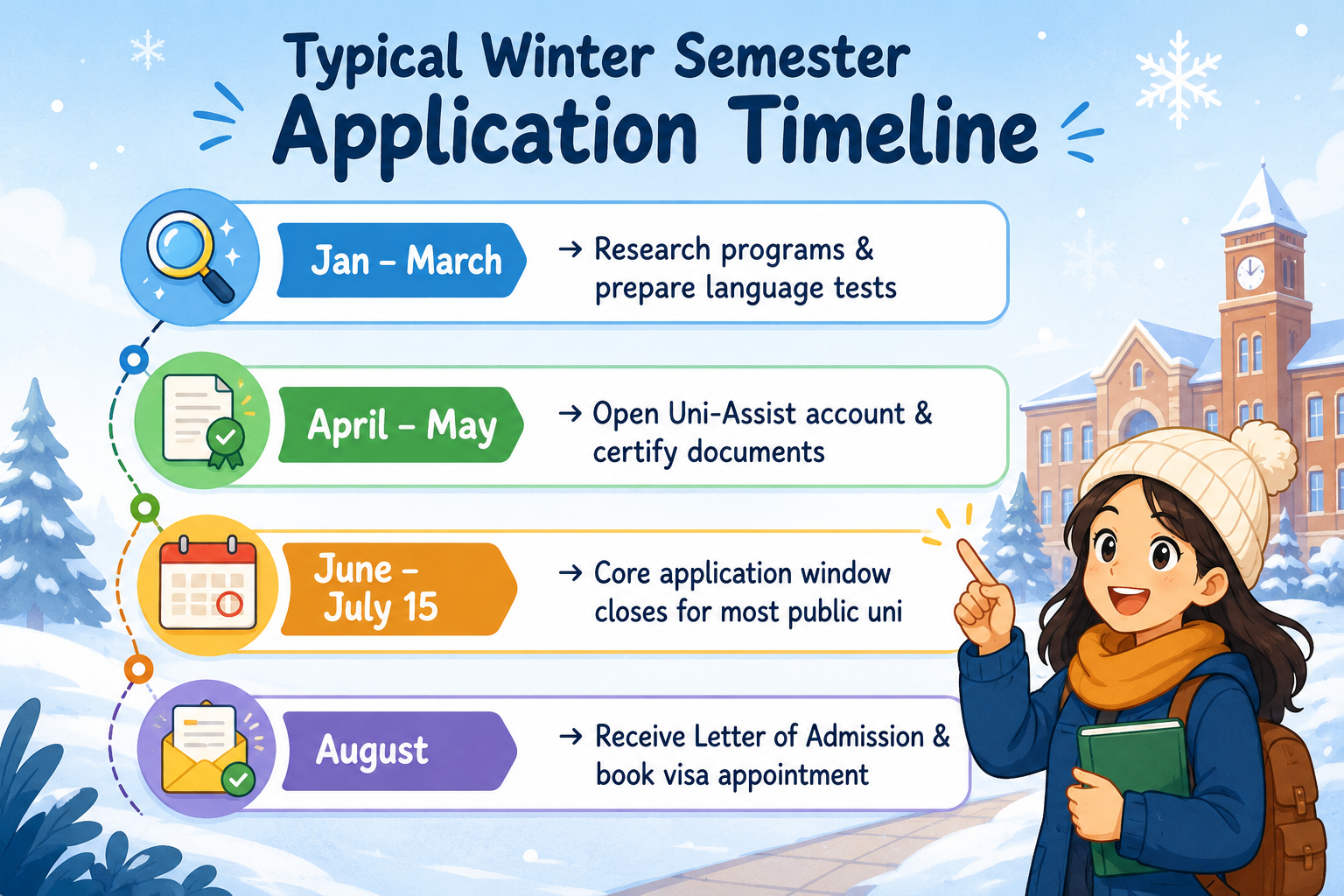
Depending on the institution, international applicants must submit their documents either directly to the university’s internal portal or via Uni-Assist—the centralized service provider that evaluates international school and university certificates for German institutions.
To secure your German student visa, you must prove to the German government that you can cover your living expenses in Germany. The most widely accepted method is opening a certified German blocked account (Sperrkonto) and depositing the federally mandated minimum amount, which ensures you can support yourself throughout your first year of study.
German academic years are divided into two terms: the Winter Semester (starting in October) and the Summer Semester (starting in April).
Pro Tip - Never wait for your official Letter of Admission to start preparing your visa documents. Secure your embassy appointment slots as early as possible, as summer peak times see incredibly high demand.
Once your visa is approved and your enrollment is finalized, you will step into an environment engineered for personal and professional growth.
Institutions like FH Münster University of Applied Sciences place a heavy emphasis on the student experience, offering structured integration pathways such as international buddy programs. These initiatives pair you with senior students who help you navigate local registration, health insurance setups, and the unique aspects of German student culture—like mastering the local bicycle networks.
By understanding how to study in Germany as an international student and systematically executing your preparation, you pave the way for a world-class education and a lucrative future career in the heart of Europe.